
Tree Trimming & Pruning Service
Think of tree trimming & tree pruning as a haircut for your trees. This service not only improves their aesthetics, but also benefits long-term health. Young trees can benefit from structural pruning - a practice we encourage to promote healthy growth of the tree, without the need for drastic pruning as it grows larger. Main branch structure is initiated and poorly attached limbs that will cross paths in the future are removed, or cut back to a proper bud or branch.
While trimming trees when young is ideal, mature trees should also be periodically pruned to remove diseased, dead or dying limbs as they can be dangerous to people and property. Canopies of mature trees can also block sunlight which will inhibit the growth of other landscaping as well as your lawn. Thinning of tree canopies can give your yard much more light and make growing plants and grass much easier. Contact Us today to get a quote on tree trimming & pruning.
 For more information, please visit TreesAreGood.org
Tree Trimming & Pruning Services
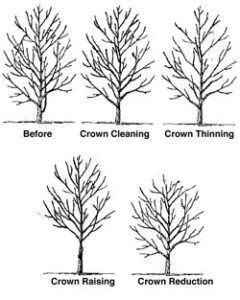
- Crown Cleaning: This involves selective pruning of dead, diseased or broken limbs.
- Canopy Raising: Elevating canopy for clearance from ground.
- Canopy Reduction: Selective pruning to reduce height and spread. This practice does not include topping.
- Tree Restoration: The pruning of limbs to restore structure after storm damage or tree topping.
- Structural Tree Pruning: Pruning to improve branch architecture.
- Thinning: This type reduces the density of the canopy and the branches within.
- Vista Pruning: This type of tree maintenance involves selectively pruning to enhance view. Mature trees have canopies that can become too dense. It is beneficial to thin the canopy to allow better air flow through.
We Do NOT Top Trees (and neither should you)!
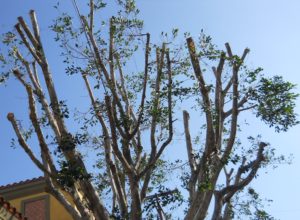 For more information about why topping is bad, please read our blog: https://fullcircletreeandshrub.com/blog/tree-topping-worst-option/
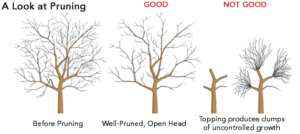
Topping is perhaps the most harmful tree pruning "practice" known. Yet, despite decades of literature and seminars explaining its harmful effects, topping remains a common practice. Sometimes a tree must be reduced in height or spread, such as for providing utility line clearance, so we offer alternative methods. Recommended techniques include removing small branches back to their point of origin. If a larger limb must be shortened, it should be pruned back to a lateral branch that is large enough (at least one-third the diameter of the limb being removed) to assume the terminal role. This method of branch reduction helps to preserve the natural form of the tree. However, if large cuts are involved, the tree may not be able to close over and compartmentalize the wounds. Sometimes the best solution is to remove the tree and replace it with a species that is more appropriate for the site.
- Topping stresses trees (removal of leaves starves a tree; open wounds make trees vulnerable to pests & disease)
- Topping leads to decay (multiple severe wounds are too difficult to compartmentalize, leaving exposed wood tissue to decay)
- Topping can lead to sunburn (without leaves to shield the branches, sunburn of tissues can lead to cankers, bark splitting & death of some branches)
- Topping can lead to unacceptable risk (new shoots that grow quickly below a topping cut are prone to breaking, especially during windy or icy conditions, increasing risk of limb failure)
- Topping makes trees ugly (topping destroys the natural form of a tree and it appears disfigured and mutilated - it can never full regain its natural form)
- Topping is expensive (increased maintenance costs, reduction of property value, increased liability potential)
 Deadwood Pruning
Deadwood can be dangerous and prevents a tree from healing, therefore possibly allowing disease or pests to penetrate the tree's system. If you see a tree with a hole in it, it may be due to a dead limb that was not removed properly.
Architectural Pruning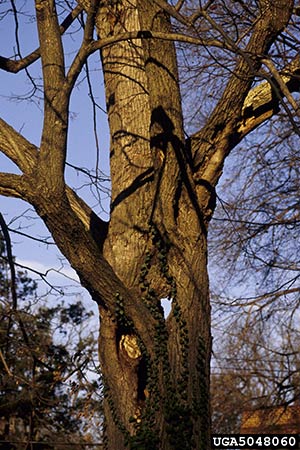 Trees with poor architecture may look interesting to the eye but several problems can arise from this type of growth habit, including crossing limbs, weak branch attachment and hidden points of decay. We recommend pruning your trees when they are young to create the best chance for success as they age.
Specialty Pruning
Full Circle offers fine technique pruning such as boxwood clouding, espalier, and pollarding.
Boxwood clouding is a technique that gives the boxwood shrubs a light and natural cloud-like appearance.
Espalier pruning is a technique that is commonly used to train fruit trees on flat surfaces, to assume a desired shape and usually require steady pruning throughout the growth season. Sometimes a guide wire is used to assist with the growth training.
Pollarding is the process of removing growth on the outer most stems of a woody shrub or tree, annually or bi-annually, for the purpose of maintaining a framework of exposed branches. Sometimes very small stems are left to provide budding and flowering of the tree. Topping is not an example of pollarding.
Preservation & Maintenance Services
Our focus is on proactive care—addressing structural integrity and health before a problem becomes a hazard.
- Structural Pruning: Shaping young and mature trees for long-term stability.
- Canopy Restoration: Scientific thinning and balancing to revive neglected or overgrown trees.
- Deadwood Removal: Enhancing safety and aesthetics by removing compromised limbs.
- Ornamental Pruning: Specialized, detailed care for delicate shrubs and specimen trees.
- Storm Damage Mitigation: Expert repair for standing or partially-damaged trees following a weather event.
Plant Health Care
We don't just look at the branches; we look at the biology. Our diagnostic-led approach ensures your landscape thrives.
- Health Diagnostics: Professional assessment and site-specific health reports.
- Growth & Root Vitality: Soil-level treatments to improve canopy vigor and root system resilience.
- Disease & Pest Management: Targeted preventative and curative protocols for local threats.
- Specialized Species Care:
- Annual Hackberry Woolly Aphid treatments.
- Biennial Emerald Ash Borer trunk injections (2-year protection).
Tree Removal Advisory
We prioritize preservation. Because we focus on maintenance, we do not perform large-scale removals. However, we act as your expert advocate when a tree cannot be saved. We provide:
- Professional Assessments: Determining if a removal is truly necessary.
- Educational Resources: Helping you understand your options and local bylaws.
- Vetted Referrals: Connecting you with trusted removal contractors while we oversee the transition.
Why "Boutique" Matters
When you hire us, you are hiring the owners and the experts—not a rotating crew of laborers. We treat your property like a living ecosystem, providing the "full-circle" care your trees deserve.
Ready to invest in the future of your canopy?